

This is the third and final article in my short series on education and parenting. If you have not read the first two, I encourage you to start there because this conversation did not begin here.
In the first, I argued that the Family Curriculum may be the most important curriculum your child will ever study. In the second, I asked whether, in choosing between international and local education, we may actually be asking the wrong question.
Read the First article: The Most Important Curriculum Your Child Will Ever Study Is Not Taught at School
Read the Second article: International or Local School? You’re Probably Asking The Wrong Question
Now I want to end the series with a much harder question:
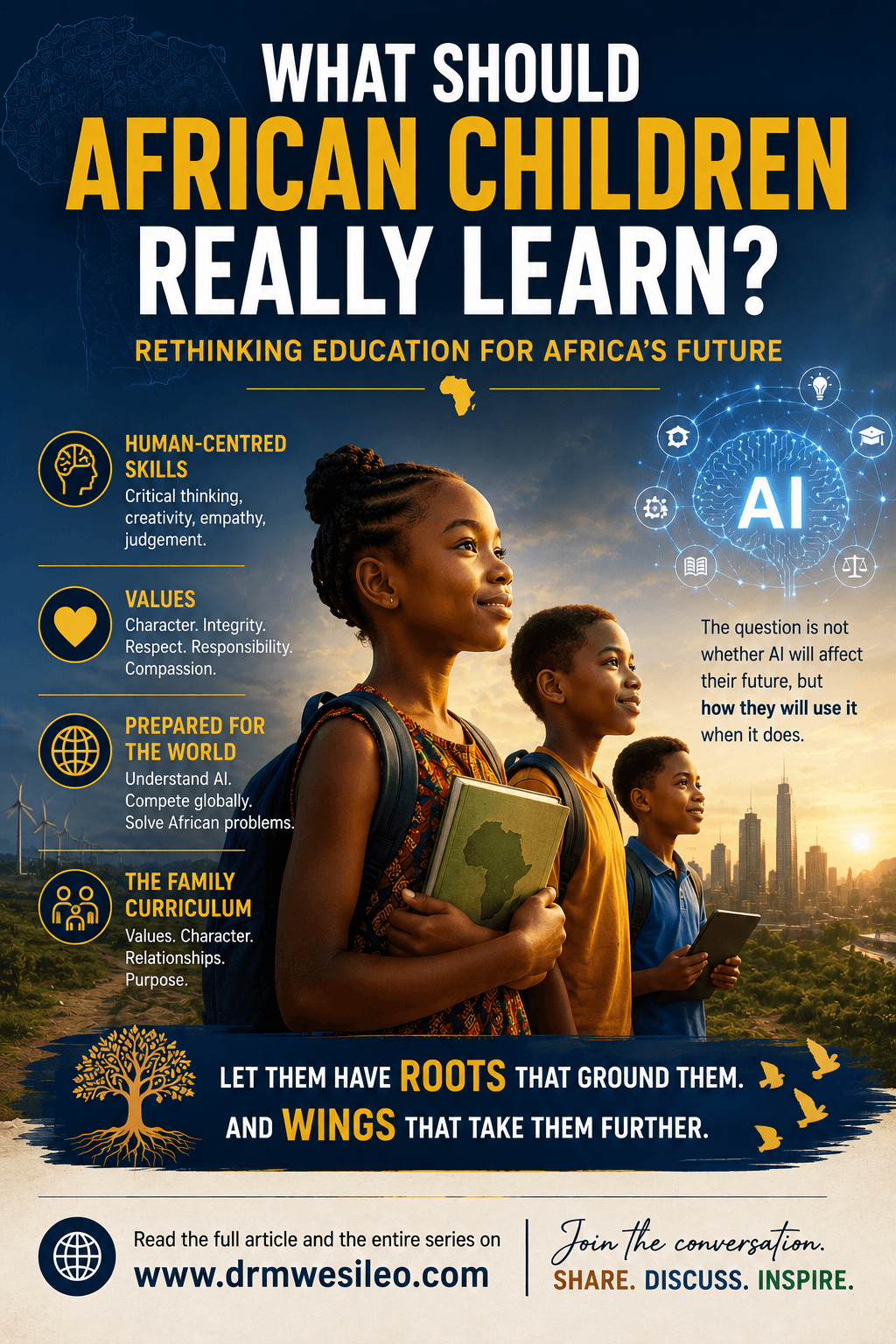
What should African children really learn?
I approach this question with humility. I am not a curriculum or education expert, and predicting the future is extremely difficult. This is simply my view & an invitation for you to reflect and form your own opinion.
Because if education is supposed to prepare children for the future, surely we should occasionally pause and ask: What kind of future are we preparing them for?
Where Does “Local” End and “International” Begin?
Recently, while officiating at a function at Acorns International School in Lubowa, a Ugandan minister encouraged international schools to blend international curricula with Uganda’s national curriculum so that children remain grounded in local values and do not lose their identity.
I understood the concern.
But that immediately raises another fascinating question: what exactly are local and international values in today’s interconnected world? Is “international” about crossing geographical borders or cultural boundaries? And if cultures, technologies and economies are increasingly interconnected, where does “local” end and “international” begin?
Africa alone is extraordinarily diverse, with an estimated 2,000 to 3,000 spoken languages and thousands of distinct ethnic groups. Yet beneath this remarkable diversity, we share much of the same history. For centuries, the continent endured the slave trade and, later, colonial rule. The very period during which much of our modern formal education system took shape. That history inevitably influenced what was taught, how it was taught and, importantly, what education was intended to achieve.
Colonial rule may have formally ended, but external influence did not disappear with the lowering of colonial flags.
Many African countries still depend significantly on external “free money” [call it grants] from former colonial powers in the name of “development partners” (…I sometimes question the “partners” bit a lot), to finance our education and other sectors.
Sometimes I wonder what kind of partnership this is.
I am certain most of you reading this know those relationships where both people are called partners, but one brings most of the money, sets most of the rules and somehow has a louder voice at the dinner table.
Hmm!
Perhaps Africa is the junior partner in this marriage. And as our wise African grandparents would probably remind us, the person paying the bills may eventually want a say in how the household is run.
That brings us to an uncomfortable but necessary question: when someone else “helps” finance your priorities, how much influence do they eventually have over what those priorities become? More importantly for this conversation, how much influence might they have over what we choose to teach the next generation?
There is no free lunch, fellow Africans!!
Even well-intentioned development “assistance” comes with objectives, preferences and priorities of its own. That does not make every donor programme bad. Many have made enormous contributions to African education. But we must have enough clarity and confidence to distinguish between what our “partners” consider important for Africa and what we, as Africans, believe is necessary for our own future.
Take one simple example: value addition.
Africa is enormously rich in coffee, cocoa, cotton, critical minerals, oil and countless other raw materials. Yet for generations, we have exported too much of this wealth in relatively unprocessed form and bought back higher-value finished products.
If our ambition is to change that model by adding value to our raw materials ourselves, then surely that is also an education question.
Who are we preparing to run those factories?
Where are we teaching the engineers who will design the processing plants, scientists who will develop new products, technicians who will maintain the machines, entrepreneurs who will build the companies and marketers who will sell African brands to the world?
We cannot spend decades saying Africa must move from exporting raw materials to exporting finished products while educating the next generation for an economy that continues doing exactly what the previous generation did.
If our history shaped the education we inherited, perhaps our ambitions should shape the education we design.
And this takes me back to a point I made in the previous article: every curriculum is ultimately preparing a child to solve someone’s problems. So whose problems are we preparing African children to solve?
And Then Artificial Intelligence (AI) Arrived!
As if answering that question wasn’t difficult enough, AI is changing the world underneath our feet. At Davos in January 2026, Elon Musk predicted that AI could become smarter than any individual human by the end 2027 and smarter than all humanity combined around 2031.
AI will touch banking, medicine, agriculture, construction, transport, education and almost every industry our children may enter. The question is increasingly becoming not whether AI will affect their profession, but how they will use it when it does.
But talking about African children, AI and Elon Musk reminds me that perhaps we should pause for a moment and reflect as Africans before we get lost in predictions about the AI future.
Musk was born and raised in Africa but eventually moved to North America, where he built his extraordinary business empire. Now imagine, for a moment, that he had returned to Africa, like many of us, to build Tesla, SpaceX and the other companies he went on to create. Would the African market, institutions, financing systems, infrastructure, and regulatory environment have enabled him to build them at the same scale and speed? Your guess is as good as mine!
This is not simply about Musk. It raises a much bigger question for us Africans. We can educate brilliant children, but what happens when the environment we create cannot fully absorb their brilliance? Many will simply take their ideas, skills and ambitions to markets where they can flourish. And ironically, even within Africa, we still struggle to see ourselves as one market. Xenophobia against fellow Africans including in Musk’s country of birth, South Africa, is perhaps one uncomfortable reminder of how disconnected we remain.
Yet, in an interesting contradiction, the African Continental Free Trade Area (AfCFTA) led by a South African citizen, Secretary-General H.E. Wamkele Mene, is attempting to build exactly the kind of integrated African market that xenophobia and our lingering national divisions continue to undermine.
If Africa is serious about creating a market of more than a billion people in which capital, skills, ideas, goods and eventually businesses can move more efficiently, then education must surely be part of that ambition too.
Back to AI and Back to the Family
Now, back to AI. After that little African detour, let us return to the world our children are actually entering.
Some of the world’s leading universities – Harvard, Oxford, Stanford and the University of Toronto, among others are already wrestling with what education should look like in an AI-enabled world. While the debate is far from settled, a familiar set of human capabilities keeps appearing: critical thinking, creativity, originality, judgement, empathy and the ability to solve problems.
That should make every parent think. Because, as I argued in the first article, the Family Curriculum is already in this classroom! An education system built primarily around storing and retrieving information from the brain becomes increasingly questionable when machines are extraordinarily good at doing exactly that. Even that powerful computer in your hand, the smartphone, already gives a child access to more information than most of us could have imagined growing up.
Perhaps our children’s advantage will increasingly come from somewhere machines struggle to replace: critical thinking, questioning, imagination, adapting, judging, collaborating, solving real problems and, importantly, remaining deeply human.
And suddenly, those things we discussed in the Family Curriculum – values, character, identity, curiosity, resilience, responsibility, relationships, family history and a sense of purpose, do not sound old-fashioned at all. They may actually be preparation for the future.
Perhaps Our Children Need Both Roots and Wings
After three articles, I still don’t think the answer is to reject international education. Neither is it to romanticize everything local.
Perhaps African children need both roots and wings.
Let them understand AI, but also understand their origins. Let them speak international languages, but also understand the stories, values and history carried in their mother tongues. Let them compete globally, but never become strangers in their own communities. Let them learn what the world has discovered, but also develop the confidence to question it, improve it and create something better.
Most importantly, let us remember where this series started: schools cannot do all of this alone. Parents cannot outsource the entire responsibility of preparing children for a future that none of us can accurately predict. The Family Curriculum matters.
We are not simply educating children to pass examinations. We are raising future parents, citizens, entrepreneurs, professionals, innovators, the clergy, and leaders who will inherit African societies with problems we have not solved and technologies we can barely predict.
So I end this series exactly where I began it, not with answers, but with questions:
- What kind of future are we preparing our children for?
- Whose problems are we educating them to solve?
- And ultimately, what should African children really learn?
I don’t pretend to have all the answers. Perhaps none of us does. And that is precisely why we need this conversation.
Parents. Teachers. Schools. Governments. Communities. We all have a role to play.
If this series has made you think, don’t let the conversation end here. Share it. Post it. Discuss it. Challenge it. Start a conversation. Thank you, C.K. for igniting this conversation.
The future belongs to our children. The education we give them today is our contribution to it.
Until next time,
Believe. Build. Be Bold.
— Dr. Mwesi Leo
 Career & Business | Productivity Systems | Financial Freedom







Leave Your Comment: