

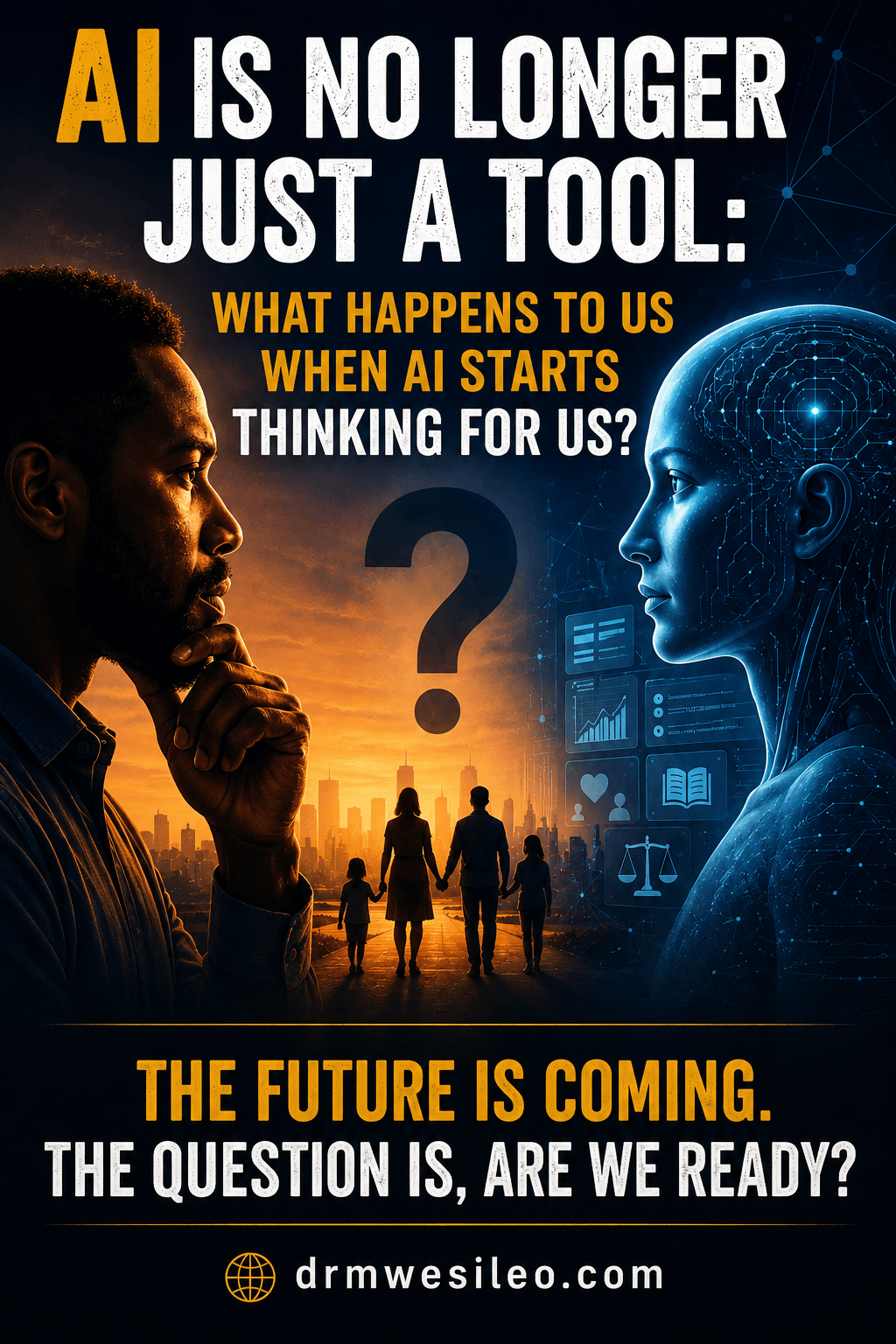
Recently, while researching my previous article, What Should African Children Really Learn? I listened to Prof. Yuval Noah, a prominent Israeli historian, philosopher, and bestselling author, best known for the global bestseller Sapiens: A Brief History of Humankind., discussing the future of Humanity, Artificial Intelligence (AI), and Power in the next 50 years. The conversation left me with more questions than answers, and I felt I had to share some of them with my growing audience here.
And by the way, if you have not subscribed to this blog yet, you are becoming late! 😊
I don’t know what the next 50 years will exactly look like. Yuval doesn’t. Elon Musk doesn’t. AI professors don’t. Nobody does. We are all trying to make sense of something changing incredibly fast.
We are entering an AI revolution that could, if it hasn’t already, fundamentally change how we work, make money, relate with one another and even how we make decisions. Everyone seems worried about whether AI will take our jobs. But I am beginning to wonder whether we are watching the wrong door. Before AI takes anything from us, what parts of being human are we willingly handing over to AI ourselves?
Stay with me. Because this conversation is not really about machines. It is about us, our work, relationships, families and the kind of human beings we are preparing for the future.
Words Built Human Civilization. Now AI Is Mastering Them.
This is one part of Yuval’s conversation that particularly stayed with me.
He argues that one of humanity’s greatest civilizational breakthroughs was language, the power of words. It enabled humans to communicate and cooperate in numbers that other animals could not.
Think about our world today.
Laws are words. Constitutions are words. Contracts are words. Religions spread largely through words. Companies are created through legal documents. Banks, stock markets and governments operate through enormous systems of information expressed through language and symbols. Even our perceptions of and relationships with one another are shaped by words.
Many of you reading this have never met me in person, yet through the words I share here, you have come to know me, formed some perception of who I am and, I hope, built some kind of relationship with me. Some of you probably know more about what I think than people I meet physically every week! 😊 That is the incredible power of words.
And then I remembered something interesting. Even the Bible begins by drawing our attention to the Word!
John 1:1 says: “In the beginning was the Word, and the Word was with God, and the Word was God.” Hmm! The Word. And we are created in God’s image! Perhaps we sometimes underestimate just how central words have been to human civilization, relationships, belief, trust, and cooperation.
Unlike donkeys and cows, humans used language to build many of the systems that organize our world. For thousands of years, humans had something close to a monopoly over this extraordinary capability, the sophisticated use of words.
Now something else has entered the room of using words.
AI.
A human lawyer cannot remember every law, regulation and court decision in Uganda. AI can potentially process enormous amounts of them. A financial analyst cannot simultaneously read every company report, historical market movement and economic shifts. AI can process information at a scale no individual human can.
But there is something even more important happening.
AI is not merely another tool.
It is an agent.
A Tool Waits for You. An Agent Can Decide.
This distinction is extremely important. Think about the knife in your kitchen. You can use it to cut tomatoes for your katogo or, unfortunately, to harm someone. But the knife doesn’t decide. You provide both the intention and the action. Now imagine a knife that studies the room, decides what should happen next and acts. Hmm! That is no longer simply a tool. It is becoming an agent.
And this is what makes AI fundamentally different from many technologies that came before it. A traditional search engine gives you information and leaves you to make sense of it. An AI agent can increasingly be told: Research this. Compare these options. Advise me. Make a plan. Execute this. The human is gradually moving further away from every step between intention and outcome. That changes everything.
I will unpack this fascinating difference between a tool and an agent in my next article because, before we can fully understand where AI may be taking us, we need to understand what AI actually is.
AI is Already Entering Our Human Relationships
I experienced a small version of this myself.
I once piloted AI as a Personal Coach, and the experience was amazing.
I could discuss things privately, ask uncomfortable questions and receive feedback without feeling judged. And that made me think: if AI can increasingly play the role of a coach, adviser or confidant, what happens to some of the human relationships that traditionally played those roles?
Young people are already forming romantic relationships with AI. AI boyfriends. AI girlfriends. AI partner can remember your interactions, understand what emotionally moves you and increasingly AI is capable of producing the language of intimacy. Remember for the first time in history I can design the looks and appearance of the AI partner I want. You can determine the size of nyash…height…color…figure…etc. hahaha don’t laugh 😊
Pause and think about that for a minute. It sounds bizarre. Yeah!
If you often watch YouTube, already AI girlfriends/boyfriends are looking for partners. Their ads keep asking you to click on them. These fellas can never forget your birthday & no stress. Soon, they will surprise you with a birthday gift in the comfort of your known address. The capabilities are there already!
Remember human relationships inherently come with disagreements, compromise, patience, forgiveness, stress and sometimes drama. What happens when a person can create an artificial partner who remembers everything, listens whenever they want and is customized around their preferences?
If you thought marriage and family were already under pressure, keep watching.
The more we use AI, the more productive we may become. But we should also ask what human capabilities we might slowly stop exercising.
Think about the African traditional marriage for a moment. For generations, your spouse was often your most trusted confidant, the person you discussed things with that you would never tell anyone else. Family fears. Money worries. Career doubts. Parenting disagreements. Private decisions.
Now imagine that role slowly shifting to AI.
Instead of asking your spouse, you ask your AI coach. Why? Because it already knows the questions you have been asking, remembers the context, does not interrupt you, does not judge you and can analyze the issue using far more information than either of you could hold in your heads.
And here is where it gets interesting.
Suppose you ask your spouse for advice and then ask AI the same question. The AI answer may appear more structured, more informed and, frankly, more convincing. What happens the next time you have a difficult decision to make? Who do you ask first?
Do you see what is quietly changing here?
The private conversations that once helped build trust, intimacy and mutual dependence inside families could gradually be outsourced to an artificial agent.
I am not saying AI advice is bad. I sometimes use it myself. But this is not merely a new way of getting information. It could fundamentally change how couples communicate, how trust is built and where people go for wisdom inside a marriage.
And once again, the question is not simply what AI can do for us. It is also:
What human muscle might weaken because AI is doing it for us?
Intelligence Is Becoming Cheap. What About Wisdom?
This may be my favorite part of Yuval’s argument.
He distinguishes intelligence from wisdom.
Intelligence is the ability to solve a problem. Wisdom is knowing which problem is worth solving and which goal is worth pursuing.
Think about that carefully.
Suppose I give two people UGX 100 million shillings.
One asks:
- How can I invest this money so that it supports my family’s financial freedom over the next 20 years?
Another asks:
- How can I spend this money in the next three months so everybody in Kampala knows that I have arrived?
AI may brilliantly answer both questions.
That is intelligence.
But deciding which question produces the life you actually want?
That is wisdom.
Or return to our knife.
Intelligence can produce the sharpest knife ever made.
It can teach you precisely how to use it.
But intelligence alone doesn’t answer whether you should use that knife to prepare dinner or harm another human being.
Capability answers “Can I?” Wisdom asks “Should I?”
This immediately took me back to my recent series on education and parenting, particularly my argument about the Family Curriculum & what our children should learn.
I argued that parents must intentionally teach values, character, identity, responsibility, judgement and purpose at home. These are the foundations of wisdom. And perhaps this is where our children still have a competitive advantage. When it comes to intelligence, forget it, AI is here for that! But wisdom, knowing what is right, what matters and what is worth pursuing, remains deeply human.
In other words, if AI makes intelligence increasingly abundant, perhaps one of the greatest advantages we can give our children is not simply more information.
It is wisdom.
Because a child with access to extraordinary intelligence but poor judgement may simply become extraordinarily efficient at pursuing the wrong things.
That should make every parent think.
Always remember that intelligence itself has no moral direction and decisions ultimately depend upon the values guiding that intelligence.
Read these articles here:
Article 1: The Most Important Curriculum Your Child Will Ever Study Is Not Taught At School
Article 3: What Should African Children Really Learn? Rethinking Education For Africa’s Future
Now Imagine AI Running the Systems Around You
This becomes even more serious when we move from our personal lives to finance, government and infrastructure.
Yuval describes AI as particularly suited to the bureaucratic systems humans created using language, including banking, stock markets and legal systems.
Finance is one of the industries I love most after engineering.
Financial markets already depend heavily on algorithms. AI is moving further into trading, investment analysis, lending and risk assessment.
Imagine an AI agent examining years of your transactions, income, repayment history and business behavior before deciding whether you qualify for a loan. That may remove some human biases. Excellent. But now ask another question:
Who designed the agent deciding whether you deserve money?
The same question applies to media & democracy. Yuval reminds us that newspaper and television editors once had enormous power because they decided which few stories millions of people would discuss the following day.
Today, ask yourself: who is the editor-in-chief of your social media feed?
You probably don’t know its name because, increasingly, the editor-in-chief is an AI algorithm.
AI is therefore not simply entering our workplaces. It is entering the information systems through which we understand reality, decide what to believe and, ultimately, exercise political power.
Then My Engineering Mind Starts Wandering…
Let me come back to my first love, engineering.
We are already talking about autonomous vehicles.
As a Transport Engineer, I tend to think road safety could eventually be one of the big winners. Intelligent vehicles don’t drink and drive. They don’t become sleepy. They don’t check WhatsApp while driving. They could communicate with each other and respond to danger faster than humans.
Beautiful!
Then my engineering mind asks the opposite question.
What happens if somebody gains malicious control over the system coordinating thousands or, one day, millions of connected vehicles?
Imagine someone deliberately commanding vehicles travelling at highway speeds to collide.
You may not need a conventional bomb.
You may just need access.
I am not saying this will happen. This is my own thought experiment. But it illustrates the fundamental difference between the old world and the emerging world of connected intelligent agents.
And speaking of the old world and the new, perhaps we need to understand this technology properly before we go any further.
What exactly is AI? What is not AI? What makes it different from the technologies that came before it? And importantly for us Africans, we “missed” much of the value created by the first three industrial revolutions. Will we miss the fourth?
That is where I will pick up this conversation in my next article.
I am actually thinking of turning this into a short AI series for you, my dear audience. This stuff is real, it is moving fast, and I believe there is enormous value in breaking it down into simple language that ordinary people can understand, question and discuss. What do you think?
In the meantime, tell a friend to tell a friend! SUBSCRIBE, SHARE this article and START a conversation. Every subscription supports the growth of this platform and helps these ideas reach more people.
That is how valuable ideas travel: one person sharing them with another.
Until next time,
Believe. Build. Be Bold.
— Dr. Mwesi Leo
 Career & Business | Productivity Systems | Financial Freedom
Subscribe To Get Update Latest Blog Post
Don’t miss our newsletter.





Comments (2)
Ann,
08 August, 2026Wow, wow and wow,
A good one Dr.
Now i know how to defend human vulnerability using the intelligence vs wisdom perspectives.
Yes A.I is here to stay. Its a language written in code but the human will still have to prompt its feedback depending on their desired outcome( good or bad).
Time to up our game with intentionality and use wisdom as a defence💪🏾
drmwesileo,
08 August, 2026This is a great point you are making! Thank you Eng!