

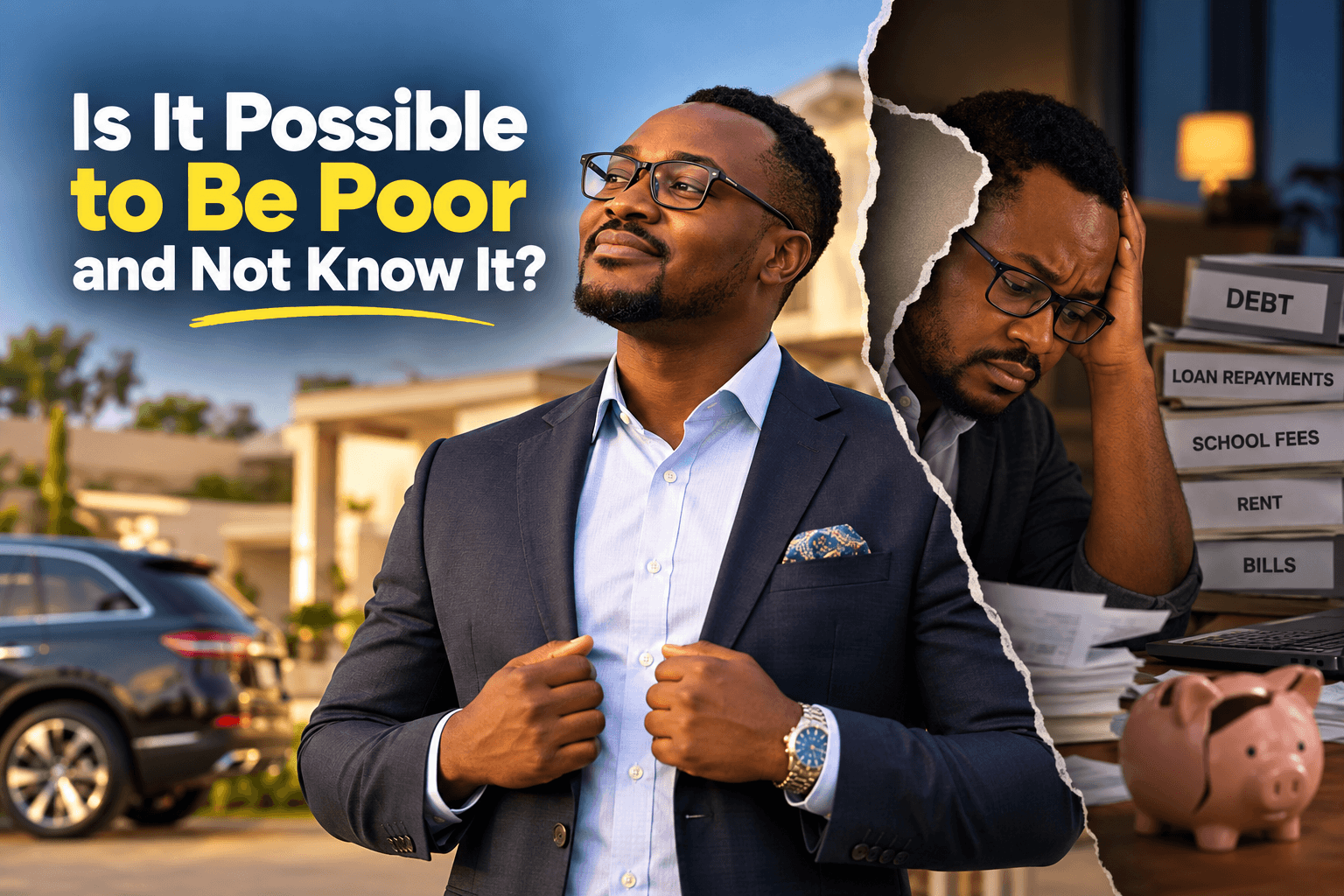
Why a good salary, a nice car and a lifestyle everyone admires may be hiding a financial reality nobody sees.
What if I told you that you could be earning millions every month, driving a beautiful car, living in a respectable neighbourhood and still be poor without knowing it?
Hmm! I know some of you are already disagreeing with me. But stay with me for a moment.
Hello, my dear readers!
It has been a while since I last checked on you. My sincere apologies! It has been about a month and a half since you last heard from me. I have been well, thank God, but extremely busy doing something I often encourage you to do on this platform: walking the talk!
You see, there is something powerful about practising what you preach. You learn lessons that no textbook can fully teach you. Speaking of books, I am currently reading The Millionaire Fastlane by MJ DeMarco, and OMG! What a book! I will certainly share some lessons from it in another article. Anyway, back to my point. You discover that what looks straightforward on an Excel spreadsheet can be quite another story when you begin implementing it. And, perhaps most importantly, every time you make a commitment to yourself and follow through, you build something extremely valuable: trust in yourself.
On 9th October 2026, Uganda’s Independence Day, by the grace of God, I added another side hustle to my financial freedom grid! This particular income vehicle had been on my plan since January 2025, and after months of preparation, it finally became operational. Customers are already coming in, and I am grateful to God for that.
Now, you know I love asking whether we are truly independent when we still depend entirely on our next salary! Hahaha! In fact, on Independence Day last year, I published an article titled Welcome Back! How to Start (or Restart) Your Journey to Financial Freedom. If you are serious about financial freedom, please read it.
Last year, I was preaching financial independence. This year, I was busy putting another piece of it into practice! Hmm! Perhaps I should make Independence Day My Annual Financial Freedom Accountability Day!
But here is what excites me even more. Beyond the prospect of earning additional income, setting up this business has introduced me to new people, relationships and opportunities I had not anticipated. Some of these connections are already opening doors to others within the same industry.
And that is another lesson I am learning: sometimes the greatest return on starting a business is not the money you make immediately, but the knowledge, relationships and opportunities you acquire along the way.
And that is why I keep reminding myself that a plan is only the beginning. Implementation is where the real education happens.
Whenever I venture into a new business, I also open a book to understand that industry. I may not need to become the best technician in the business [please read “The E-Myth Revisited by M.E. Gerber” to understand what I mean], but I must understand the trade well enough to supervise my team, recognise problems and ask intelligent questions.
How else would I know whether my team is telling me the right things?
Anyway, as I promised when I started writing about financial freedom, I will continue sharing the lessons I learn from building my side hustle businesses. Not just theories from books, but experiences from the field.
And today’s lesson came from a rather interesting encounter at a bank.
Meet JJ, the Banker Who Got Me Thinking
One of the people I recently met was a gentleman I will call JJ.
JJ works at a bank where I had gone to open an account for my new business.
Now, depending on the nature of your business in Uganda, opening a bank account can involve quite a bit of paperwork. For this particular business, one of the requirements was registration with the Personal Data Protection Office (PDPO), and the associated documentation was quite tedious.
While we were working through the requirements, JJ was also guiding other customers who wanted to open similar accounts.
As we interacted, he became curious.
“So, what do you do for a living?” he asked.
I told him where I work.
“Eeeh! You guys are okay!” JJ exclaimed.
I looked at him.
“What do you mean, JJ?”
He explained that my employer pays very well and that, in his view, someone working for such an organisation could hardly be poor.
I almost fell off my chair!
Here was a banker, someone who interacts with people’s financial affairs every day, telling me that a good salary is almost a guarantee against poverty.
Of course, I could not tell what JJ knew about anyone’s actual finances, and I was not about to discuss my colleagues’ financial circumstances.
But his assumption fascinated me.
As I often do when meeting new people, I had already started trying to understand his mindset about money, wealth and financial freedom. I find that a few minutes of conversation can tell you quite a lot about how someone thinks, although understanding their actual financial position is another matter.
So I asked him a question.
“JJ, do you know that someone can be poor and not even know it?”
“Not possible!” he replied.
Hmm!
And that, my dear readers, is where our conversation became very interesting.
Poverty Can Wear a Suit!
When we hear the word poverty, what comes to mind?
Perhaps a person struggling to put food on the table. Someone living in a poor neighbourhood, unable to pay school fees or meet basic household needs.
And yes, that is poverty in its most visible form. We must never minimise the hardship experienced by people who genuinely lack sufficient income to meet their basic needs.
But there is another condition I want us to discuss today: financial poverty hidden behind a seemingly successful lifestyle.
You can have a good salary, a beautiful house, an expensive car, fashionable clothes and a very active social life, yet have no meaningful savings, no investments, no income-producing assets and debts that consume nearly everything you earn.
In fact, your lifestyle may be financed almost entirely by your next salary.
Consider two people.
One earns UGX 10 million every month but spends UGX 11 million. The difference is covered through loans, salary advances or borrowing from friends.
Another earns UGX 1 million, lives on UGX 700,000 and consistently saves or invests the remaining UGX 300,000.
Now tell me, who is moving towards financial freedom?
Of course, the second person is not necessarily wealthy, and a low income can make saving extremely difficult. But the example illustrates something important: earning more money and building wealth are not the same thing.
You can earn a lot and accumulate nothing.
You can increase your salary every year and still remain trapped in the same financial position because your expenses rise just as quickly, sometimes even faster.
That is what I mean when I say that poverty can wear a suit!
Sometimes what we mistake for wealth is simply financial fragility dressed very nicely.
The Question That Can Expose Your Financial Position
Do you remember my friend Lucius?
I introduced him in my earlier article, When Should You Take a Loan? How to Borrow Smart and Avoid Costly Debt Mistakes.
Lucius helped us explore an important lesson: borrowing money is not necessarily bad. What matters is why you borrow, the terms of the loan and whether the debt strengthens or weakens your financial position.
Now, imagine asking Lucius this question:
“If your salary stopped coming tomorrow, how long would your current lifestyle survive?”
Not how long you would survive by borrowing from friends.
Not how long the bank would tolerate your missed loan repayments.
And certainly not how long you could keep up appearances!
I mean, how long could your savings and other sources of income sustain your essential household expenses?
One month? Three months? Six months? A year?
That answer can tell you more about your financial resilience than the car parked outside your house.
You see, society has conditioned us to compare lifestyles rather than balance sheets.
We notice where someone lives, what they drive, where their children go to school, which restaurants they visit and where they spend their holidays.
But rarely do we ask the more important questions.
How much do they own?
How much do they owe?
What assets generate income for them?
And what happens when their primary source of income disappears?
A high income can finance an expensive lifestyle. But it takes financial discipline, productive assets and a deliberate plan to build lasting financial freedom.
That distinction is fundamental.
When Financial Disorder Becomes Normal
There is another reason some people may not recognise their financial vulnerability.
They are surrounded by people living exactly the same way.
Everyone has a loan.
Everyone is waiting for payday.
Everyone is borrowing to maintain a certain lifestyle.
Everyone plans to start investing when they get their next salary increment or promotion.
And because everyone seems to be doing it, nobody thinks there is a problem.
But remember something I have repeatedly emphasised in my financial freedom discussions: what is common is not necessarily what is right.
You can spend twenty years earning a respectable salary and have very little to show for it beyond the memories of what you consumed.
I am not suggesting that we should stop enjoying life. Far from it! Money should help us live meaningful, comfortable lives.
But there must be a balance between enjoying today’s income and building tomorrow’s financial security.
Otherwise, we may spend our most productive years financing a lifestyle that we cannot sustain when our earning power declines.
And this is where financial freedom becomes such an important goal.
Financial freedom is not simply about how much money you earn. It is about progressively reducing your dependence on having to work continuously to meet your living expenses.
That is why I am building multiple income vehicles. Not because I believe every business will succeed or that entrepreneurship is easy, but because I want to build productive assets and systems that can eventually support my desired lifestyle without depending entirely on my salary.
And believe me, implementing that ambition is teaching me quite a few lessons!
So, Are You Poor Without Knowing It?
Before you answer, I want you to conduct a small personal financial examination.
Find a quiet place, perhaps this evening, and ask yourself these four questions:
If my main income stopped today, how many months could I meet my essential expenses without borrowing?
What assets do I own that currently generate income, or are likely to grow in value over time?
Am I using my income to build wealth, or mainly to maintain a lifestyle that impresses other people?
If I continue with my current financial habits for the next ten years, will I be financially stronger or simply ten years older?
That fourth question is particularly important.
Because time alone does not make us wealthy.
A person can work for thirty years and still retire financially vulnerable. Another can use those same years to gradually accumulate savings, investments, productive assets and financial security.
The difference is not always the amount of money earned. Often, it is what they consistently do with the money that passes through their hands.
Of course, circumstances matter. Some people simply do not earn enough to meet basic needs, and no amount of financial discipline can fully compensate for inadequate income. Increasing earning capacity is therefore also part of the journey.
But for those of us fortunate enough to earn reasonably well, we must confront an uncomfortable possibility:
We may not have an income problem. We may have a money management problem.
And the earlier we recognise that distinction, the better.
My Final Word to JJ, and Perhaps to You
As I explained to JJ, working for a well-paying organisation does not automatically make someone wealthy.
A salary is an income stream. Wealth is built through what you retain, how you deploy it, the assets you accumulate and the financial resilience you create.
The two are related, but they are not the same.
And that is why I believe one of the most dangerous financial positions is to be financially vulnerable while believing you are wealthy.
The good news?
You can do something about it.
Start by understanding where your money goes. Reduce destructive debt. Build an emergency fund. Develop the habit of saving and investing. Improve your earning capacity. Gradually acquire assets that can generate income independently of your daily labour.
You do not have to do everything at once.
But you must begin somewhere.
Because, as they say, you cannot solve a problem you have not identified.
Perhaps the first step towards financial freedom is not receiving more money. It is becoming financially honest about where you actually stand.
And remember, my dear reader: looking wealthy and becoming wealthy are two very different projects. Be careful which one is consuming your money!
Before I Go, What Happened to Our AI Conversation?
I know some of you are probably wondering what happened to the AI series.
In my last article, What Is AI, Really? Africa “Missed” Three Industrial Revolutions. Will We Miss the Fourth?, I promised to return with another important discussion:
Who Controls AI? And What Should Africa Do Differently This Time?
That promise still stands!
In fact, I have some interesting developments to share with you. AI is evolving so rapidly that even the terminology we use to describe its capabilities is changing. Hmm! By the time we finish understanding one development, another is already knocking at the door.
But don’t worry. I will absolutely return to that conversation. There is too much at stake for Africa for us to abandon it.
For now, I wanted to share this little lesson from my recent entrepreneurial experiences because, as I have always maintained, this platform is about life, business, productivity and our collective journey towards financial freedom.
And the lessons I learn while walking that journey are the very lessons I want to share with you.
So stay here, my dear readers!
Subscribe to the blog, share this article with a friend and help us grow this community of people who are not just dreaming about better lives, but deliberately building them.
And before you leave, tell me something in the comments:
Can someone earn UGX 20 million a month and still be poor? What do you think?
Until next time, tell a friend to tell a friend!
Until next time,
Believe. Build. Be Bold.
— Dr. Mwesi Leo
 Career & Business | Productivity Systems | Financial Freedom
Subscribe To Get Update Latest Blog Post
Don’t miss our newsletter.
You May Also Like

Leave Your Comment:
Leave Your Comment:



Comments (8)
Puche David,
10 October, 2026Good afternoon OB, very good piece, I need physical interaction with you, I pray the Almighty enables us to meet
drmwesileo,
10 October, 2026Yes, Eng! Glad to hear from you. Yes we shall meet! God will allow it to happen. I can’t wait to see you! Stay blessed!
Moses,
10 October, 2026Wonderful article more so when it comes to that question 4 are growing financially after 10yrs or just growing old er/younger financially
Dr.thanks for sharing .
drmwesileo,
10 October, 2026Oh yeah! It scares when u think about it deeply! Thanks for appreciating my brother!
Twesigomwe Denis,
10 October, 2026Thanks so much Dr. Eng. Leo for the powerful sharing, I have picked from the experience shared and calling on action.
drmwesileo,
10 October, 2026That’s encouraging to hear! Thanks Eng Dennis!
Amutuhaire Peninah,
10 October, 2026Wonderful! Thank you engineer .
drmwesileo,
10 October, 2026Oh pleasure my sister!