

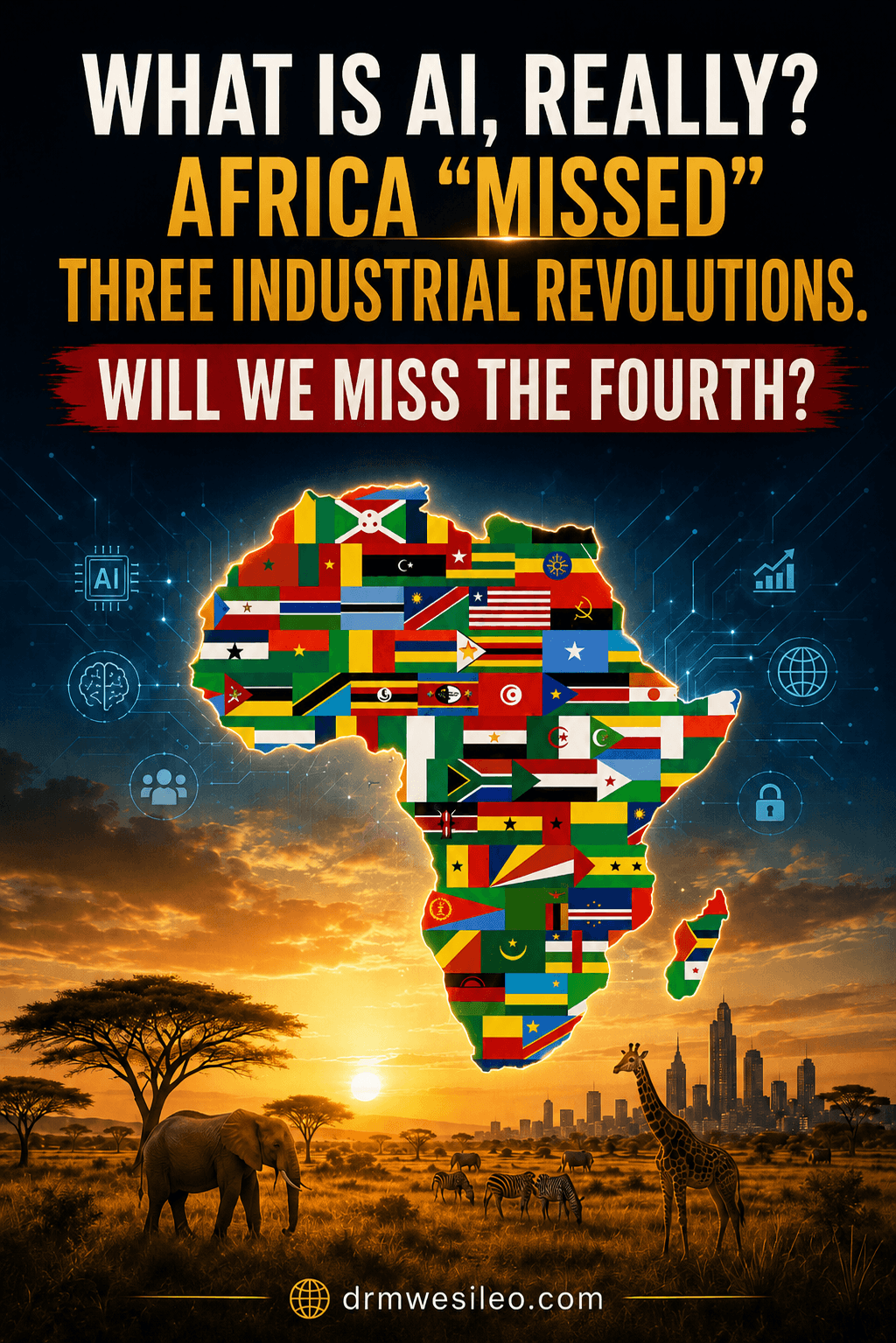
Artificial Intelligence (AI) is coming for your job! AI will make our children lazy! AI will replace teachers, doctors and lawyers! AI will become more intelligent than humans!
You have probably heard some version of these statements. Some are genuine concerns. Others are predictions, exaggerations or simply misconceptions about what AI actually is.
But I want us to go deeper than that.
Humanity has been at this point before. New technologies have repeatedly changed how we produce, work, trade, fight wars and, ultimately, which societies become powerful. We went through the steam revolution, electricity and mass production, computers and the internet. Each revolution created winners, losers and new centers of economic power. And Africa’s position in that history should make us pay particular attention to what is happening now.
But before we travel back through that history, let us first understand the technology at the center of this new revolution.
What exactly is AI? What is not AI? And what makes it different from the technologies that came before it?
Let us start with the simplest point: not every clever machine or computer system is AI.
Your ordinary calculator is not AI simply because it calculates faster than you. An automatic coffee machine is not necessarily AI because you press cappuccino and it produces one. A standing order that transfers money from your bank account on the 30th of every month is automation, but that alone does not make it AI.
Why?
Because these systems largely follow instructions already given to them. Artificial Intelligence goes further.
In simple terms, AI enables machines to perform cognitive tasks that we normally associate with human intelligence. It can learn patterns from enormous amounts of information, understand and generate language, recognize images, reason through problems, make predictions, create new content and increasingly make decisions and take actions.
And AI is much bigger than ChatGPT.
When many of us hear AI today, we immediately think of ChatGPT or another chatbot. But Generative AI is only one visible face of a much larger technology. AI is already helping banks detect fraud, lenders assess risk, hospitals interpret medical images, platforms recommend what we watch, navigation systems predict traffic, factories detect defects and vehicles increasingly understand the environment around them.
So what really makes AI different?
Like I explained in my previous article, a tool waits for you. An agent can increasingly make decisions.
AI Series Article 1: AI is No Longer Just a Tool: What Happens When AI Starts Thinking for Us?
Let us return to the coffee machine for illustration purposes. You press cappuccino and it makes one. That is automation. But imagine walking towards the same machine and, before you touch anything, it says:
Dr. Leo, I have been observing you. It is Monday morning, you look tired, and from what I have learned about your habits, I think you need an espresso. I have already made one.
Hmm!
Then perhaps the following morning it says:
By the way, I studied your preferences and created a new drink that I think you will enjoy more than espresso. Try it.
Now something fundamentally different is happening. The first machine followed instructions. The second observed, learned, predicted, decided and created.
That is the important distinction between automation and agency.
Think about even the most powerful technologies humans have created. An atomic bomb possesses unimaginable destructive power, but it cannot decide which city to bomb. A human being must make that decision. AI introduces something fundamentally different because machines can increasingly participate in deciding what happens next.
That is also why ChatGPT is not simply Microsoft Word with better grammar. A traditional word processor waits for you to write. Generative AI can interpret what you are trying to achieve, generate alternatives, critique them, revise them and, increasingly through AI agents, perform sequences of tasks towards an objective.
This is what makes the present moment so fascinating. For centuries, we built machines that extended the power of our muscles. Then we built machines that calculated, stored and transmitted information faster than us. Now we are building machines that increasingly extend, imitate and sometimes outperform parts of our minds.
That is cognitive agency, territory that for most of human history belonged largely to humans.
But perhaps AI becomes easier to appreciate when we realize that it did not arrive in a vacuum. Humanity has experienced other technologies that completely reorganized economies, societies and global power. To understand why this particular revolution may matter so much, let us travel backwards for a moment and see what happened during the revolutions that came before AI.
We Have Seen Revolutions Before. But This One Is Different
Human beings have always developed technologies that expanded what we could do. But occasionally, a technology changes production, economies and society so profoundly that historians call it an industrial revolution.
The First Industrial Revolution, beginning in the late 18th century, brought mechanization, steam power and the factory system. Machines amplified human and animal muscle. Railways and steamships transformed how goods and people moved.
The Second Industrial Revolution, from the late 19th into the early 20th century, brought electricity, steel, chemicals, telecommunications and mass production. Factories became enormously more productive, and goods could be produced at a scale humanity had never seen before.
Then came the Third Industrial Revolution, beginning around the middle of the 20th century: electronics, computers, telecommunications and eventually the internet. Machines were no longer merely strengthening our muscles. They were helping us calculate, store, process and transmit information.
Look carefully at that journey.
Steam engine amplified muscle.
Electricity transformed production.
Computers amplified calculation and information processing.
The internet connected people and information.
Extraordinary technologies. But fundamentally, they remained tools.
A steam engine did not decide where the train should go. Electricity did not decide what the factory should manufacture. A computer did not decide what problem needed solving. Even the internet gave us unprecedented access to information, but humans still have to search, read, interpret and decide what to do with it.
Then comes AI.
Like I have already discussed, AI is not simply another more powerful tool. It is an agent.
It is a Fourth Industrial Revolution technology that deserves particular attention.
And now, fellow Africans, this is where history becomes uncomfortable.
If every industrial revolution creates winners and losers, where were we during the first three?
We certainly participated. But for much of this history, Africa participated disproportionately as a supplier of raw materials and physical labor, while much of the industrial technology, machinery, intellectual property and higher-value production was developed elsewhere.
And traces of that history are still all around us.
Think about agriculture. In 2026, millions of African farmers still depend heavily on the hand hoe to produce food. While other societies have moved from mechanization to automation and now towards intelligent machines, many of our people are still relying on human muscle to do work that the First Industrial Revolution began transferring to machines more than 200 years ago.
Pause and think about that.
Sometimes I hear our leaders proudly announce how many new factories have been built, and part of me wants to whisper: Your Excellency, factories were the revolution of the 18th and 19th centuries. The world is now discussing AI and intelligent factories! Of course, we still desperately need factories and the jobs they create. But we must also ask: what kind of factories are we building? A labour-intensive African factory must compete in the same market with a highly automated Chinese factory using AI, operating 24/7 and producing enormous volumes at lower unit costs and consistent quality. If we industrialise using yesterday’s technology while our competitors industrialise using tomorrow’s, we may build factories and still lose the market!
And there is another uncomfortable reality. Even many of the labor-intensive factories we are building rely on technology developed elsewhere, imported here and operated by us. We may own the factory building and provide the labor, but much of the machinery, technology and know-how that drive production still come from elsewhere. In many ways, therefore, we are still playing catch-up with the first three industrial revolutions while the fourth is already taking off.
Remember history suggests that technological revolutions do not wait until everyone is ready.
Let Us Travel Back to 1498
President Museveni often illustrates Africa’s technological challenge using the fascinating history of how the continent eventually came under European colonial rule.
If there is one person who has made me fall in love with history, it is our President. He knows his craft! He can take you back hundreds of years and somehow show you why events that happened then still matter to the life you are living today. As a scholar, I admire that ability. I have read and listened to his speeches for so many years that sometimes I can almost predict his next sentence. Perhaps I am also becoming AI for him… hahaha!
Anyway, let us get serious again.
In many of his historical reflections on Africa, Museveni takes his audience back to the arrival of European explorers on Africa’s coasts. Vasco da Gama rounded the Cape of Good Hope in 1497 and reached the East African coast in 1498 on his journey to India. These early voyages and the European presence that followed were part of a much longer historical process that would eventually culminate in the colonization of most of Africa centuries later.
Museveni tells this history in his own characteristically provocative way. His argument is that Africa was not colonized because we lacked dancers, storytellers/historians or musicians. We had plenty of those! We were eventually conquered because we had fallen behind in science and technology. As he puts it, Europeans had gunpowder. We did not. It was not because Africans lacked courage.
Fellow Africans, we know this colonization movie very well!
Imagine ‘aka’ tiny Kingdom, Belgium dominating the vast Congo. How? … because of enormous technological and military imbalance. Put very simply, it became something of an action movie of guns against spears and bows. We all know how it ended. DRC will never be the same again! And, in different forms, that technological imbalance formed part of the story across much of the continent.
But here is the part of Museveni’s argument that fascinates me most.
European contact with Africa’s coasts had been developing from the 15th century, yet the great Scramble for Africa did not begin until the 1880s. About 400 years had passed! Yeah, pause and think!
Museveni’s point is essentially this: information was coming to the African Kings that some powerful people were coming. There were signals, yet instead of recognizing the emerging danger and preparing for it, some of our kings were busy being entertained and flattered by the “clowns” around them with grand titles: the lion, the bravest of men, the wisest of all, the ruler of everything under the sun… you know the kind!
You may laugh at the way M7 tells the story, but pause and think about the underlying point.
The colonizing powers did not all suddenly appear one morning and surprise an entire continent.
There were signals.
Information travelled.
The technological gap was growing.
And eventually, the consequences were enormous.
Fast-Forward to 2026: Have We Seen This Movie Before?
Now let us return to today.
Fellow Africans, someone is coming again.
Actually, let me correct myself.
Someone is already here.
And now, allow me to play the “all-knowing one” for a moment and tell you: the ‘ruler/controller’ of the future is already among us!
AI.
Generative AI is here. AI-assisted machines are here. AI-generated images and videos are here. Algorithms already influence what billions of people see on social media. AI is entering marriages, relationships, education, finance, transport, engineering and almost every other industry.
And what we are seeing today may eventually look like the infancy of AI.
Perhaps, therefore, our generation has received its own version of that historical message:
Some powerful technology is coming.
Except this time, it is not coming aboard ships and canoes.
It is already sitting in the phone in your hand.
So what are we doing with that information?
Will we repeat the pattern of the previous industrial revolutions?
Our kings watched the technological gap grow around them. Today, their successors have different titles: Your Excellencies, Presidents of the Republic! They periodically gather at the African Union headquarters in Addis Ababa, issue communiqués, take the family photograph and return home. But I have an uncomfortable question for them: do our modern-day kings fully appreciate what is coming, and are they preparing this continent for it?
Remember, fellow Africans, today’s presidents occupy the seats our kings occupied in the 15th century. The titles have changed. The palaces have changed. The world has changed. But history will ask them exactly the same question: when you were warned that a powerful new technology was coming, what did you do about it?
African data goes out. African users help generate the interactions from which systems improve. African businesses pay subscriptions. African governments buy services. African professionals become excellent users.
Meanwhile, many of the most powerful models, advanced chips, major data centres, intellectual property, capital and companies remain largely elsewhere.
If that becomes our principal role in the AI revolution, have we really participated in it, or have we simply become sophisticated consumers of another technology created elsewhere?
This time, fellow Africans, we have been warned.
Our generation cannot say nobody told us. We can see this revolution unfolding in real time. We can use the technology ourselves. Our children are already interacting with it.
The warning is no longer arriving through stories of strange ships and canoes somewhere beyond the Cape of Good Hope.
So what should Africa do?
Hmm! That question deserves an article of its own.
Because understanding AI is one thing. Understanding who controls it, who owns the infrastructure behind it, who captures its economic value and what Africa must do differently this time is another conversation altogether.
That is where I will pick up this journey in the third article of this AI series:
Who Controls AI? And What Should Africa Do Differently This Time?
For now, I leave you with one question:
We had centuries of warning before the industrial age left much of Africa behind. AI is giving us another warning in real time. What will we do differently this time?
In the meantime, tell a friend to tell a friend! SUBSCRIBE, SHARE this article and START a conversation. Every subscription supports the growth of this platform and helps these ideas reach more people.
Until next time,
Believe. Build. Be Bold.
— Dr. Mwesi Leo
 Career & Business | Productivity Systems | Financial Freedom
Subscribe To Get Update Latest Blog Post
Don’t miss our newsletter.
You May Also Like


Leave Your Comment:
Leave Your Comment:


Comments (2)
Samuel,
08 August, 2026So now the bare truth is that we as Africans haven’t even started the first industrial revolution, technology is barely imported and ours is to operate, so the question is; can we do something in the evolution of the fourth industrial revolution which is AI when we haven’t even started the first evolution? Because truth being told, jumping those stages might be a mith, I propose we focus starting on grassroots, even if we’re so far behind, if we could only start, we can catch up but thinking that we can participate in the evolution of AI as Africans, it may sound impossible
drmwesileo,
08 August, 2026Thanks Samuel for your comment and I hear you. I think we need to do a catchup on the last revolutions and compete on the 4th otherwise we will forever be losers!