

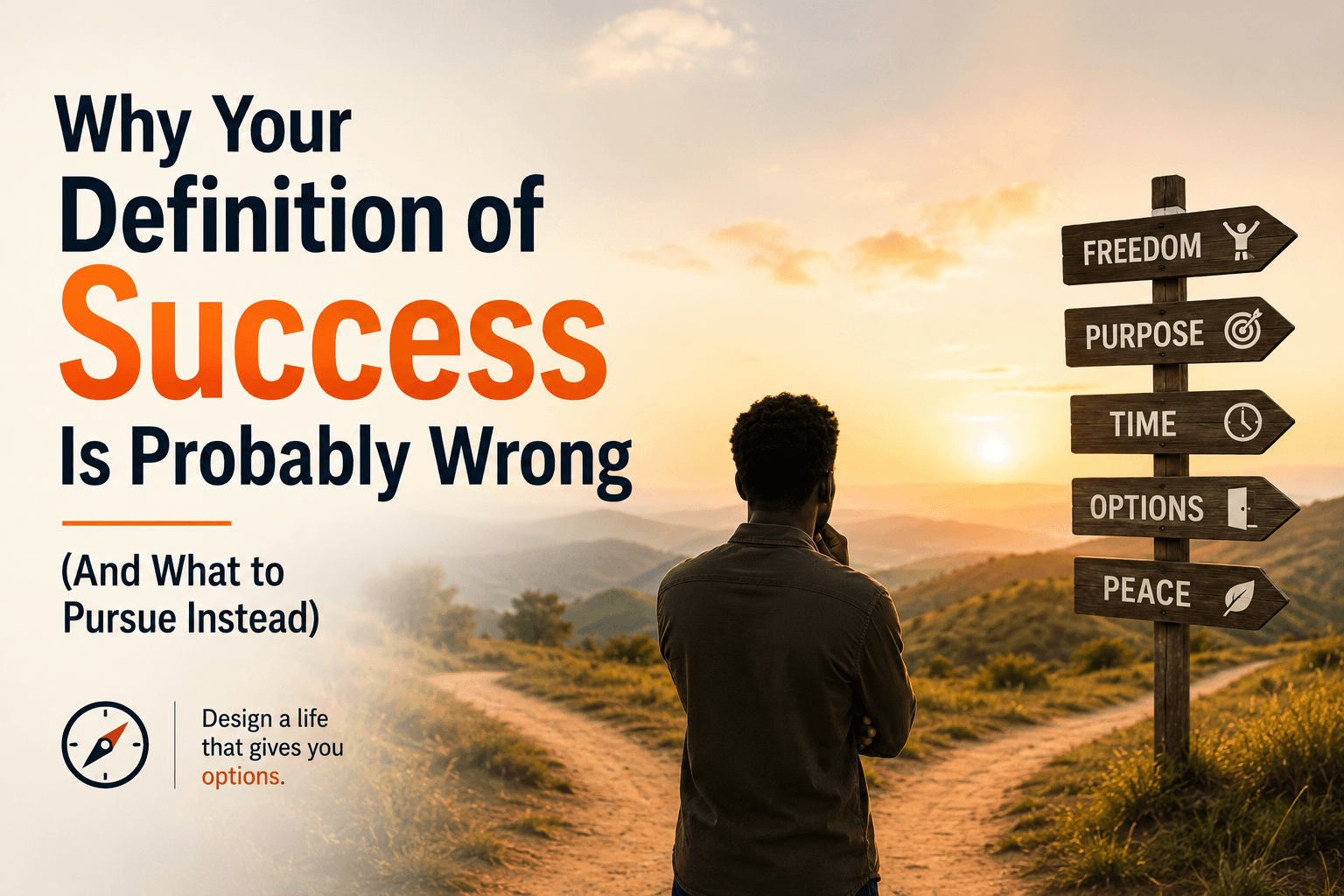
A few years ago, I thought success was straightforward.
Get good grades. Earn a degree(s). Secure a good job. Buy a car. Get married. Build a house. Climb the career ladder. Increase your income.
Simple.
Or so I thought.
As I have grown older, interacted with people from different walks of life, and reflected on my own journey, I have come to a surprising conclusion:
Many of us are pursuing goals that were never our own design.
We inherited them from society, family, friends, social media, colleagues, or simply from observing what everyone else seemed to be chasing.
The problem is not that these goals are bad. The problem is that we often pursue them without asking a simple question:
Is this really what success looks like for me? [emphasis here: FOR ME?]
The Dangerous Programming We Rarely Question
Think about it.
How many people are working hard to buy things they do not really need, to impress people they do not particularly like, while sacrificing the things that matter most to them?
Some people are chasing promotions they do not even want or need. Others are building businesses they secretly or unknowingly hate. Some are accumulating assets while neglecting their health, families, or peace of mind.
The challenge is that society tends to offer a standard definition of success. It usually revolves around money, status, titles, possessions, and visibility.
But life is not standardized.
Neither is success.
The goals that motivate a 25-year-old graduate may be completely different from those of a 40-year-old parent, a 55-year-old executive, or a retiree seeking peace and purpose.
Success evolves because life evolves.
Success Changes as Life Changes
When you are young, success may mean opportunity. You want exposure, experience, skills, adventure, and growth.
A few years later, success may mean stability.
You begin thinking about marriage, children, housing, and financial security.
Later still, success may mean impact.
You start asking questions about legacy, mentorship, community, and contribution.
And eventually, success may mean freedom.
Not freedom from work, but freedom to choose how you spend your time, who you spend it with, and what you dedicate your energy to.
This is why comparing your life to someone else’s is dangerous.
You may be comparing your Chapter Three to someone’s Chapter Twenty.
Or worse, you may be comparing your priorities to theirs when your circumstances are completely different.
Financial Freedom Is Really About Options
One of the biggest misconceptions I see today is the idea that financial freedom is a number.
People ask me:
“How much money do I need to be financially free?”
The truth is that financial freedom is less about a specific amount and more about the options available to you.
In my article on Personal Financial Management, I argued that money should serve a purpose, not become the purpose itself.
The same principle applies here.
Read: Personal Financial Management: A Practical Guide to Budgeting, Tracking Expenses, and Setting Goals.
Financial success should be understood in terms of options.
The options money can buy.
And perhaps more importantly, the options money can preserve.
Options are what allow you to change careers without panic.
Options are what allow you to take time off to care for a sick parent.
Options are what allow you to support a child through school, recover from a business setback, or survive an economic downturn without your entire life collapsing.
Sometimes the most valuable options are the quiet ones.
The ability to sleep peacefully because you have an emergency fund […in your Unit Trust Account not under your pillow].
The confidence that comes from knowing one unexpected expense will not destroy your plans.
The flexibility to say “no” to opportunities that conflict with your values.
That is a different type of wealth.
And it is often far more important than the number people display on social media.
The Wealth Nobody Talks About: Time
As I reflected on this idea, I realized that one of the most overlooked forms of wealth is time.
Many people spend decades pursuing financial freedom while sacrificing the very life they are trying to improve.
They postpone relationships. They postpone rest. They postpone health. They postpone happiness. In many cases, they postpone living altogether.
Yet life is not static. The way we spend our time should reflect the stage of life we are in. A student allocates time differently from a young professional. A parent with young children faces different priorities from an entrepreneur building a business. Likewise, a retiree will define balance differently from someone in the middle of their career.
This is where the Wheel of Life framework becomes useful.
Read: How To Set Meaningful Life Goals Using The Wheel Of Life Framework.
It reminds us that balance does not mean giving equal attention to everything at all times. Rather, it means intentionally allocating our time, energy, and resources according to our current season of life.
Personally, I believe I am in a planting phase of my life. I have mobilized many tools and I am now building while learning, unlearning and relearning, saving and investing aggressively for the future.
Because of that, I cannot afford to consume all the seeds I should be planting, no matter the pressure from family, friends, society, or even my own desires.
I do not care who says what at this stage! I will save aggressively and invest aggressively while still paying attention to my health, relationships, and personal growth.
However, I fully expect this balance to evolve over the next decade as my responsibilities, opportunities, and priorities change.
As I work toward creating a better future, I constantly remind myself not to neglect the present. One of the greatest enemies of financial freedom is early gratification at the expense of tomorrow. Equally dangerous is sacrificing today entirely for a future that is never guaranteed.
The challenge, therefore, is to find the right balance for your season of life.
Use the Wheel of Life to honestly assess where you are, identify what matters most right now, and intentionally design a life that aligns with both your present realities and your future aspirations.
The goal is not perfection.
The goal is alignment.
Because success in one area of life means very little if every other area is quietly collapsing.
A Better Definition of Success
If I were asked today to define success, my answer would be much simpler than it was years ago.
Success is having enough freedom, flexibility, and alignment to live according to your values at your current stage of life. Even some values change with time!
Notice that I did not mention a big salary, job title, net worth target, the car you drive, the looks of your spouse, [add on this list].
Those things may contribute to success, but they are not success itself.
As I discussed in my article about finding direction in life, clarity often comes when we stop asking what the world expects from us and start asking what matters most to us.
That is where GPS becomes useful again:
G – Goal: What do you truly want?
P – Plan: How will you get there?
S – System: What habits will keep you moving?
Read: From Excuses to Execution: Start Your Side Hustle with a GPS
Because at the end of the day, the objective is not to build someone else’s dream.
It is to intentionally design your own.
And perhaps that is the most meaningful definition of success after all.
Until next time,
Believe. Build. Be Bold.
— Dr. Mwesi Leo
 Career & Business | Productivity Systems | Financial Freedom
 Comment |
  Share |
  Like |
  Subscribe







01 Comment
Success Is Not a Zero-Sum Game: What 15 Years in the Workplace Taught Me,
06 June, 2026[…] my previous article, Why Your Definition of Success Is Probably Wrong (And What To Pursue Instead), I argued that many people spend their lives pursuing goals that were never truly their own. We […]