

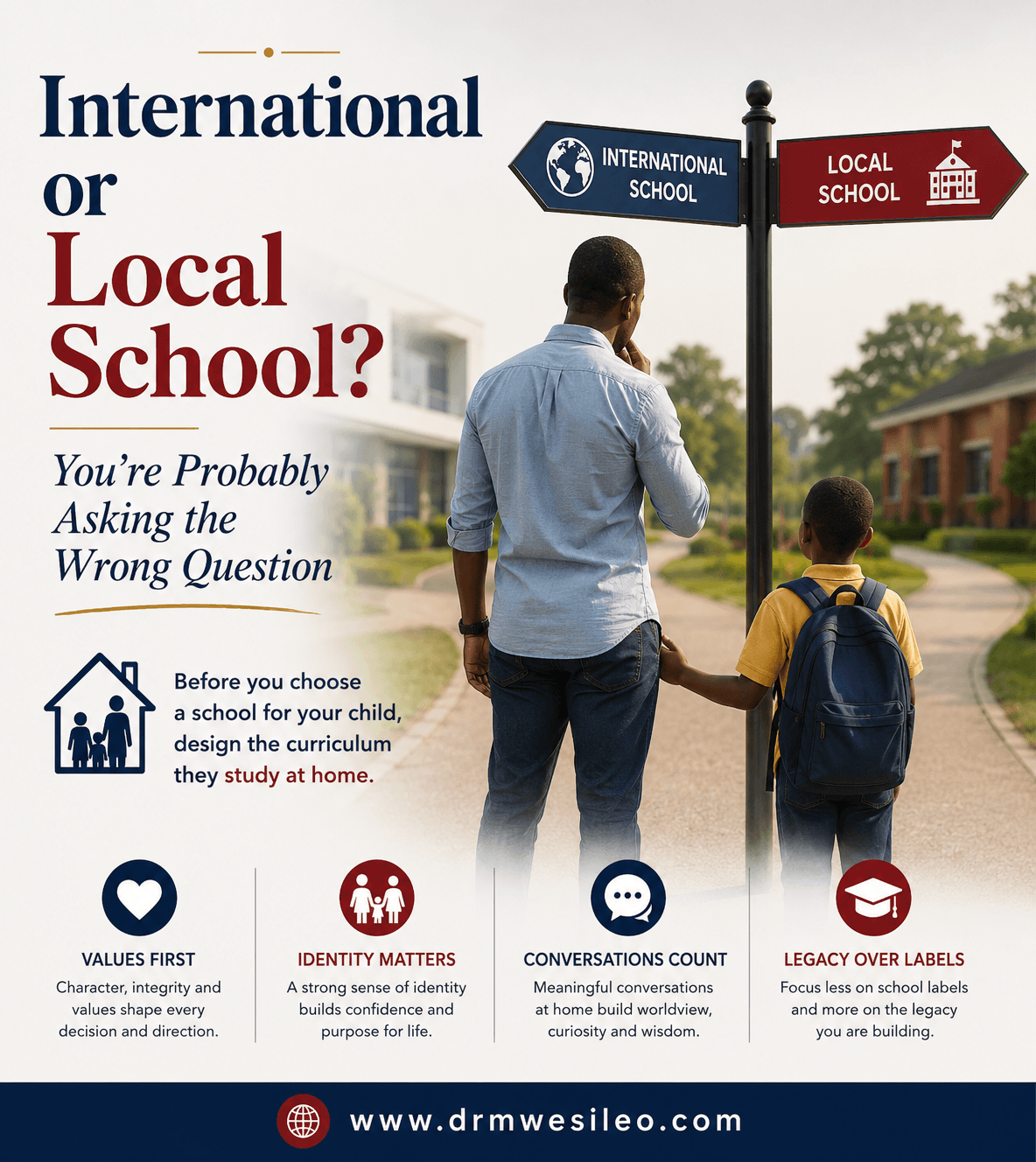
One of the most common education questions I receive from friends and relatives is this:
“Dr. Leo, should I enrol my child in a school that offers an international curriculum or one that follows Uganda’s national curriculum?”
To be honest, my answer is always the same: It depends.
Before we go any further, it is worth distinguishing between a school and a curriculum. A school is the institution where a child learns. A curriculum is what that child is taught. The two are not always the same, and some schools today offer more than one curriculum. For simplicity, throughout this article I use international school to refer to a school primarily offering an international curriculum, and local school to refer to one primarily following Uganda’s national curriculum. My concern, however, is less about those labels and more about whether the education your child receives fits your family’s circumstances, values and long-term aspirations.
Now that we’ve made that distinction, my answer remains the same: it depends.
Parents rarely like that answer. They want a verdict. They want me to declare one curriculum superior and release them from the anxiety of making such an important decision.
I understand their concern. Choosing a school for your child can feel like choosing their future. Parents worry that one wrong decision at nursery or primary level might permanently close doors.
But sometimes, beneath that genuine concern, there is something else.
- Pressure
- Prestige
- The desire to belong to a certain social class.
Before giving my humble opinion, I usually ask the parent one question:
“Why do you believe the international curriculum is better for your child?”
The responses are often revealing.
Out of 10 parents, 9 may begin by saying, “Many of my friends take their children to that school.”
The remaining one will probably say, “I want my child to make connections with important people.”,
You hear that Minister X or a famous businessman Y takes their children to a certain school, and suddenly that becomes the school’s strongest selling point.
- Not its teaching philosophy.
- Not how it supports different learners.
- Not its values.
- Not whether its curriculum aligns with the family’s future.
Just the people in the parking lot of the school.
Prestige Is Not a Curriculum
Whenever someone tells me, “Minister so-and-so takes their children there,” I am tempted to ask:
Do you know where that minister went for his/her primary school?
President Yoweri Museveni attended Kyamate Primary School. Vice President Jessica Alupo attended Apuuton Primary School in Katakwi. Prime Minister Robinah Nabbanja attended Nkooko Primary School. Uganda’s Speaker of Parliament Jacob Oboth-Oboth attended Muwafu Primary School in the Tororo District. The Deputy Speaker of Parliament attended Kigarama Primary School in Mitooma District. My sector Minister for Works & Transport, Hon. Fred Byamukama attended Kikwaya Primary School in Kakumiro, the list goes on and on.
Move across the political aisle and the pattern remains interesting.
Robert Kyagulanyi attended several primary schools, including Arya Primary School in Kamwokya and St Aloysius Bukalagi, among others. Dr Kizza Besigye attended Kinyasano Primary School and later Mbarara Junior School.
Imagine their parents making those school decisions many decades ago.
Could Mzee Amos Kaguta have looked at young Museveni at Kyamate and confidently predicted that he would one day become President?
Could the parents of children in Apuuton, Nkooko, Kinyasano or Bukalagi have known exactly where their children’s journeys would lead?
Of course not.
That is the point.
A child’s future is extremely difficult to predict from the name of their primary school or the curriculum they attend.
I am not saying children who attend prestigious schools cannot become national leaders, entrepreneurs, academics or influential professionals. Of course they can and they are.
What I am saying is that meaningful connections in adult life are not created only through childhood classmates. People will often enter important rooms because of their character, competence, values, contribution and the problems they can solve – not simply because of the uniform they wore in Primary Four or Grade 11.
Your child’s most valuable future connection may not be an old boy or old girl from primary or secondary school. It may be someone attracted to who your child has become. That’s why I argued last week that the Family Curriculum matters more than the school curriculum.
If you missed Article 1 of this blog series, Read here: The Most Important Curriculum Your Child Will Ever Study Is Not Taught At School
So, before stretching the family budget because a minister’s child attends a particular school or curriculum, pause.
In Uganda, where the President once famously described his Cabinet as one of “fishermen,” perhaps following ministers’ school choices without examining your own family circumstances deserves a second thought!
Why International Schools Came Here
International schools were not originally created as status symbols for local families.
Across developing countries, many began to serve children of European expatriates, diplomats, aid workers and international professionals who needed continuity with curricula from their home countries.
Uganda’s first international school opened on 17 May 1967 as the Lincoln School, later becoming the International School of Uganda.
Its original purpose made sense.
A diplomatic or expatriate family might live in Uganda for three years, move to Nigeria, return to Europe and later relocate to Asia. Their child needed a curriculum that could travel with them.
Today, international education serves a much broader audience. Ugandan families may choose it because they expect to relocate, want globally recognized qualifications, prefer a particular teaching approach, or plan for their children to attend universities abroad without the stress of having to equate their local qualifications.
Those can all be legitimate reasons.
But “My friends send their children there” is not an education strategy.
Neither is “important people take their children there.”
Ask Better Questions
Instead of beginning with, “Which school [international vs local] is more prestigious?” begin with questions such as:
- What kind of learner is my child?
- What values guide our family?
- Where is our family likely to live during the next five years?
- Can we sustain the fees without turning the household into a permanent financial emergency?
- What does the school actually teach beyond the attractive buildings and polished marketing? After all, how a curriculum is delivered may matter more than the curriculum itself.
- How does it handle creativity, discipline, identity, technology, sport, failure and children who learn differently?
- Will my child remain grounded in the language, history and realities of the society around them?
Before choosing a school, every parent should first ask what kind of education they want their child to receive and what future that education should prepare them for. Only then should they ask which school is best placed to deliver it. Let me be clear. I am not suggesting that international curricula are inferior. Far from it. They have produced remarkable graduates across the world.
My question is much simpler.
Whose problems is your child being prepared to solve?
Always remember that every curriculum is designed to solve someone’s problems!
Imagine preparing a child for one context while they spend the rest of their life working in another.
Imagine teaching an African child everything about snow but very little about drought.
If education is about preparing children for the future, then choosing a school should begin with one simple question: What future am I preparing my child for? That question has become even more difficult to answer in an era of artificial intelligence and rapidly changing technologies.
No school curriculum can evolve as quickly as the world itself. That is why the Family Curriculum has never been more important. It is at home where children can continuously learn curiosity, adaptability, resilience and lifelong learning – the very qualities that will help them thrive, regardless of how the future unfolds.
Unfortunately, many parents start with a different question altogether.
And perhaps the most uncomfortable question of all is this:
Am I choosing this school for my child, or for the image I want other parents to have of me?
That single question may save some families from years of unnecessary financial and emotional pressure. International curricula often come at a significant financial cost, and school fees are not a one-time expense – they become part of a family’s long-term financial structure. If one parent loses a job, a business experiences a downturn, or another child joins the family, can that decision still be sustained?
There is little wisdom in enrolling a child in a school that forces the household to live in constant financial anxiety. Children notice that stress too.
Both Curricula Have Strengths and Gaps
I have studied and taught alongside people from both systems, here in Uganda and at several international universities, check my bio.
Yes, there can be differences in confidence, classroom participation, writing, creativity, exposure and approaches to problem-solving.
But those differences do not come from the school curriculum alone.
The home environment matters enormously.
A confident child may have been encouraged to ask questions at home. A financially responsible child may have been included in family conversations about money. A culturally grounded child may have spent time with grandparents and learned their language, stories and history.
Likewise, a child can attend the most expensive school and still grow up without discipline, identity, gratitude or direction.
Studying an international curriculum at foundation level does not automatically produce a global mindset. Studying a local national curriculum does not automatically limit a child’s global thinking.
The school provides one curriculum.
The family provides another.
And as I argued in the first article in this series, the Family Curriculum may ultimately be the more powerful of the two.
Choose Fit, Not Fashion
The right school is not necessarily the most expensive one.
It is the school that fits the child, the family’s values, its financial reality and its long-term plans.
For one family, that may be an international curriculum.
For another, it may be Uganda’s national curriculum.
For many, the best answer may be a thoughtful blend: strong local grounding, global exposure, active parenting and access to the educational resources technology has now made widely available.
So, should you choose an international school or a local school?
It depends.
But before you decide, remove your friends, ministers, social media and the school parking lot from the discussion.
- Look at your child.
- Look at your family.
- Look at the future you are intentionally preparing for.
Then choose objectively.
Because the purpose of education is not to help parents keep up appearances.
It is to prepare a child to live meaningfully, think independently and contribute value wherever life takes them.
If this article has made you think differently, help someone else think differently too. SHARE it with another parent, POST it on your WhatsApp status, SEND it to your family group, and START meaningful conversations at home, at work, in your church, and throughout your community. SUBSCRIBE to the blog and join a growing community committed to raising the next generation intentionally.
Coming Next
In the final article in this series, I will explore an even more difficult question:
What should African children really learn?
In a globalized world of international qualifications, artificial intelligence, migration and rapidly changing identities, what does it mean to raise a child who is globally capable but still deeply grounded in who they are?
Until next time,
Believe. Build. Be Bold.
— Dr. Mwesi Leo
 Career & Business | Productivity Systems | Financial Freedom









Leave Your Comment: