

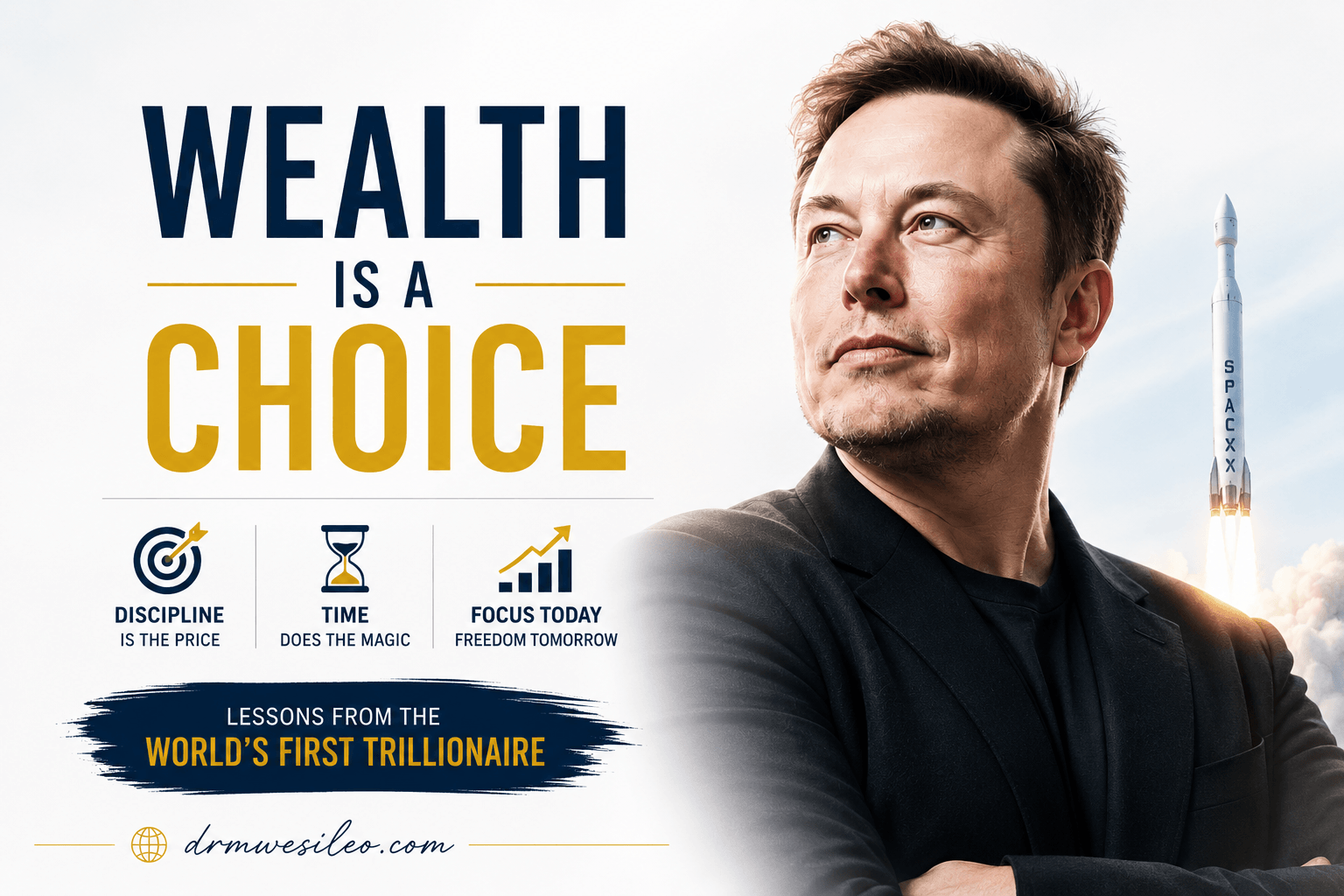
June 2026 went down in history as the month the world witnessed its first-ever trillionaire: Elon Musk.
A lot has been written about the man—his work ethic, his leadership style, his controversial personality, and his unconventional decisions. Whether you admire him or dislike him, one thing is difficult to deny: Elon Musk is an exceptional human being.
And if you have read enough about him, watched documentaries, or listened to people who have worked with him, you almost conclude that becoming the world’s first trillionaire was not a miracle. It felt like a matter of time.
One detail about Elon always stands out for me.
He is a migrant.
He arrived in North America as an outsider with ambition, curiosity, and a willingness to take extreme risks. That alone should inspire many people reading this.
But among the many stories about him, there is one lesson I want my audience to reflect on.
After selling PayPal, Elon reportedly walked away with about USD 180 million.
Here is what he did with it.
He invested:
- USD 100 million in SpaceX
- USD 70 million in Tesla
- USD 10 million in SolarCity
That adds up to his entire proceeds.
And then?
He borrowed money for rent.
Pause there.
Read that again.
The man sold a company for USD 180 million and still borrowed money to pay rent because he invested everything into the future.
Now forget the USD 180 million.
Let us bring this conversation to Kampala.
Suppose you received USD 10,000 today—about UGX 38 million.
Or better still, think about that bonus, land sale, retirement package, commission, or contract payment you expect this year.
What would you do with it?
That is the real question.
Because money does not only reveal what we want.
It reveals who we are.
Many of us do not struggle because we earn too little. We struggle because the moment money arrives, our consumption wakes up faster than our discipline.
Suddenly, you remember that trip to the beautiful islands on Lake Victoria.
Suddenly, your wardrobe feels outdated.
Suddenly, your phone feels too old.
Suddenly, every desire becomes urgent.
I have seen people in Kampala receive UGX 1 million, roughly USD 260, and they cannot sleep until that ka money is finished and they are back to zero.
Seriously?
What Elon’s story teaches me is simple:
Success, wealth, and financial freedom are highly predictable.
Not easy.
Not quick.
But predictable.
That is why I often talk about the GPS framework and the Wheel of Life.
Read:
- How to Set Meaningful Life Goals Using the Wheel of Life Framework.
- From Excuses to Execution: Start Your Side Hustle With a GPS
You need a system.
You need a formula that works for you.
Of course, each person must figure out their own formula, but the fundamentals seem remarkably constant: discipline, delayed gratification, focus, consistency, and time.
That is the part many people dislike.
We want compounding returns without compound discipline.
But compounding works on everything.
Money compounds.
Skills compound.
Discipline compounds.
Networks compound.
Unfortunately, bad habits compound too.
Debt compounds.
Indiscipline compounds.
Excuses compound.
That is why intentionality matters.
Sometimes the contradictions are obvious.
Someone says, “I want financial freedom.”
Yet every action they take moves them in the opposite direction.
At some point, we must accept a hard truth:
Financial freedom is a choice.
And every meaningful choice comes at a cost.
You may need to delay comfort.
You may need to keep using public taxis when you can barely afford a car.
You may need to invest when everyone expects you to spend.
You may need to disappoint people who feel entitled to your money.
Even Elon had to fight both external pressure and internal debate. Remember, everyone knew he had sold PayPal. The pressure to look rich must have been enormous. Yet he chose the future over appearances.
Whether you love Elon Musk or hate him is beside the point.
There is something to learn from him.
And by extension, there is always something to learn from people who have achieved what you aspire toward.
Success leaves clues.
Wealth leaves patterns.
Financial freedom rarely happens by accident.
It is built through discipline, patience, sacrifice, and time.
Make good choices.
Then allow time to perform its magic.
Until next time,
Believe. Build. Be Bold.
— Dr. Mwesi Leo
 Career & Business | Productivity Systems | Financial Freedom
You May Also Like




Leave Your Comment: