Start With What You Know
When I decided to create this platform, my goal was simple: to help you create more value (which translates into more money), grow that money, and ultimately attain financial freedom.
Yes, a part of that happens through career progression—but the real leap comes from building systems-led side hustles.
A few friends asked me, “Will you share the exact strategies you use in your businesses?”
Of course, Yes. But more importantly, I want to share something even greater—the fundamentals.
Because strategies change like seasons. Fundamentals don’t.
They are the building blocks of everything great you’ll ever create—whether in your career, business, or personal growth.
The Five Buckets Framework
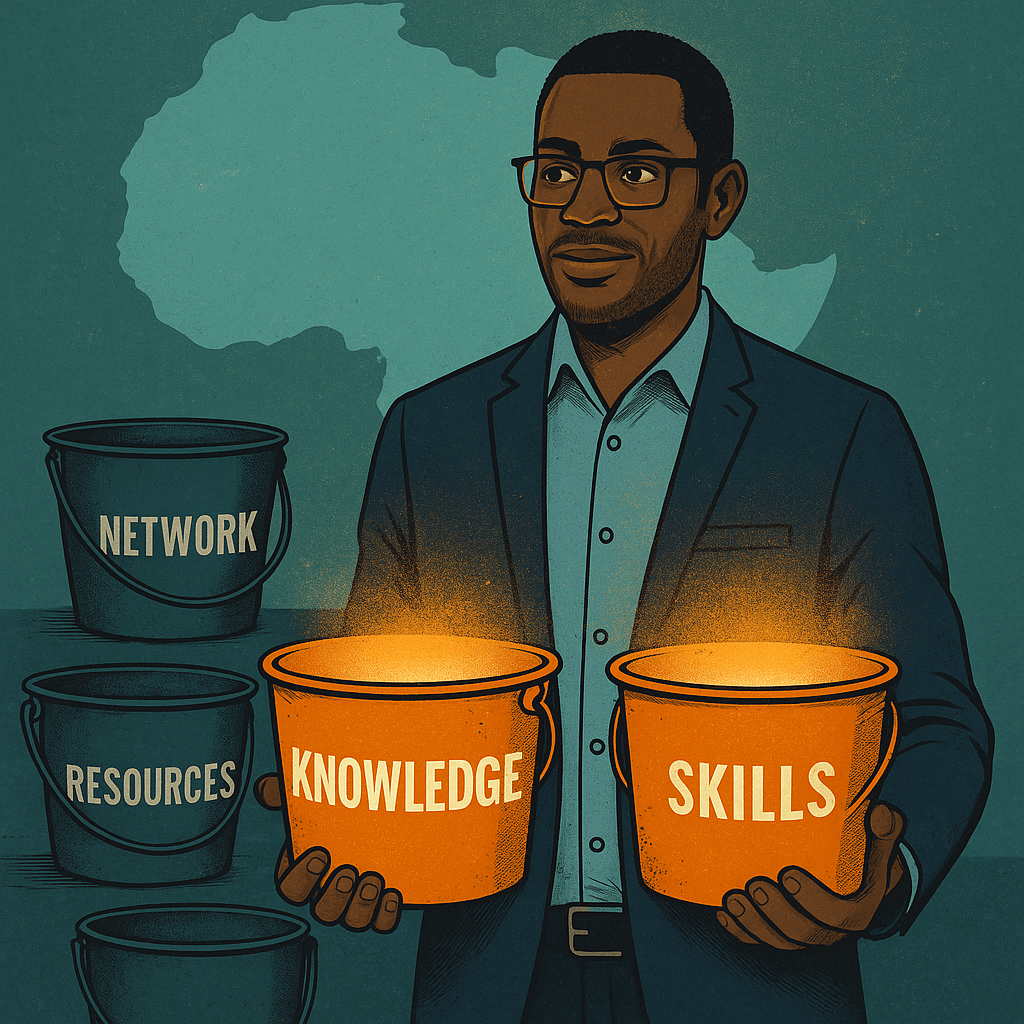
In his book The Diary of a CEO, Steven Bartlett beautifully describes five buckets that determine success:
- What you know — your knowledge.
- What you can do — your skills.
- Who you know — your network.
- What you have — your resources.
- What the world thinks of you — your reputation.
Each bucket pours into the next.
You start by learning (knowledge).
Then you practice what you know (skills).
With skills, you become valuable—and valuable people attract networks.
From networks come resources.
And from those four, your reputation is born.
Think about it this way: the most valuable people in any economy—doctors, engineers, artists, entrepreneurs—got there by filling the first two buckets first.
Knowledge gives you direction.
Skills turn that direction into motion.
An investment in the knowledge bucket yields the highest returns—because when you apply it as skill, the remaining buckets begin to fill themselves.
Knowledge and Skills: The Foundation
Let’s be honest: there’s no shortcut here.
If you want long-term, sustainable results, you can’t skip the first two buckets.
You can’t build a strong network without knowing something worth sharing.
You can’t grow your resources without doing something valuable.
And reputation? That’s simply your knowledge and skills echoing in the world.
These two buckets are the engine of progress. They are what set you apart in the crowded marketplace—and they are the first tools you’ll need on your journey to financial freedom.
Where Do You Start?
If you already have a job, congratulations—you’re standing on fertile ground.
Your workplace is your first classroom for building knowledge and skills.
Ask yourself:
- Who are your organization’s customers?
- What problems are you helping them solve?
- What complementary products or services do they need?
That’s where side-hustle ideas hide—in the blind spots of your current environment.
Next, take inventory:
- What do you already know?
- What can you already do?
- Which hobbies or skills could solve someone’s problem?
Nothing is off the table. List your assets—time, money, tools, experience—and start where you are. A side hustle doesn’t have to be glamorous. It just needs to solve a problem—and bring value.
In Uganda, even an extra UGX 200,000 a month can be life-changing.
It could pay off debt, boost savings, fund school fees, or help your parents restock the shop.
That’s not “small”—that’s freedom beginning to take shape.
For starters, Read the Top Side Hustles Most Likely to Succeed in Kampala in 2025.
Passion or Purpose?
You’ve heard it said: “Follow your passion.”
I say—follow your purpose.
Be passionate about WHY you’re doing something, not just what you’re doing. Your idea must make sense economically.
If it doesn’t have a market, it’s a hobby. And hobbies don’t buy freedom.
Once you’re financially secure, you can circle back to the passions that don’t pay—purely for joy.
Until then, chase purpose with clarity.
Identify, Validate, and Execute
- Identify a Problem and Define a Solution – Start from what you can offer. You’ll spot problems that align with your skills faster—and you’ll act sooner.
- Validate Market Need – Study your environment. Does your solution solve a real pain? Are people already spending money on it?
- Run the Numbers – If it doesn’t make money, it’s not a business—it’s a hobby.
The goal is to create more value and get rewarded in return.
Build From the Inside Out
In my last article, How to Create a Brand That Sells Your Side Hustle Before It Even Exists,
I shared that you are your first product.
While researching for this post, I came across Robin Nakintu’s story—how her sense of style in school inspired admiration, which she later turned into a full-time fashion business. Read her inspiring full story here: Think a 9-to-5 is enough? Think again.
That’s what happens when knowledge, skills, and self-awareness intersect.
So, let’s start there:
- Assess your five buckets.
- Focus on filling the first two until they overflow into the rest.
The goal isn’t to chase every new tactic—but to build yourself so strong that every strategy eventually works.
Because while strategies expire, fundamentals endure.
Until next time,
Believe. Build. Be Bold.
— Dr. Mwesi Leo
✍🏾 Career & Business | Productivity Systems | Financial Freedom
📝 Comment | 💬 Share | ❤️ Like | 🔔 Subscribe








Comments (3)
James,
11 November, 2025If this is embranced, then young entrepreners can never cry of investing in their home country.
drmwesileo,
11 November, 2025You are absolutely right, James! Thank you so much for the feedback!
From Skills to Solutions: How to Turn What You Know Into a Business That Pays – Dr. Mwesigwa Leonard,
11 November, 2025[…] week, in my article The Five Buckets of Success: Why Knowledge and Skills Come First, I shared Steven Bartlett’s analogy of how success builds layer by layer. Let’s recap […]